

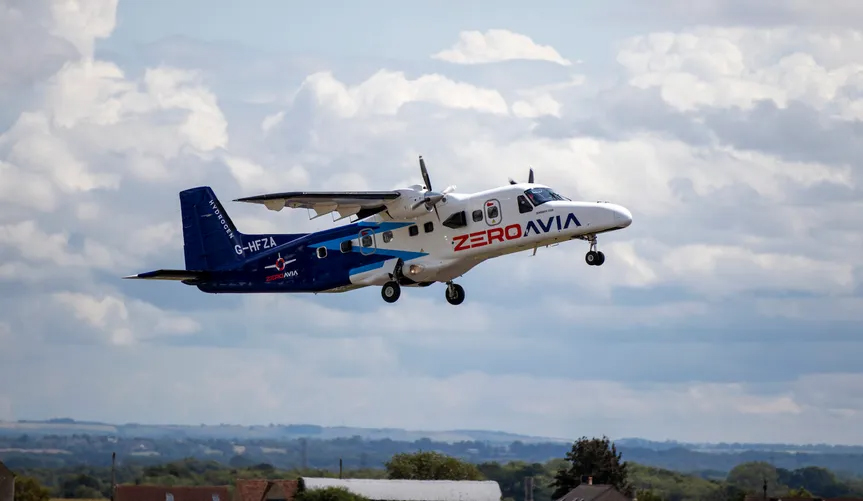
Aircraft retrofitted with hydrogen fuel cells could slash CO2 emissions from small planes — and potentially pave the way for hydrogen jets, new study shows.
A potential solution to carbon-free flying is inching closer to reality.
Since the start of this year, small planes equipped with hydrogen fuel cells have made their first test flights over the U.S. West Coast and the English countryside. The aviation startups ZeroAvia and Universal Hydrogen now claim their novel aircraft will be ready to start flying commercially as early as 2025.
A new analysis suggests that, if the technology can scale, it could sharply reduce greenhouse gas emissions for certain planes — and potentially lay the groundwork for decarbonizing broader swaths of the global aviation market.
Retrofitting a propeller plane with fuel cells and liquid-hydrogen tanks would result in a nearly 90 percent reduction in life-cycle emissions, compared to the original aircraft, according to the International Council on Clean Transportation (ICCT), a nonprofit think tank. That’s assuming the hydrogen is made using only renewable electricity —not with fossil fuels, the way the vast majority of hydrogen is produced today.
Fuel cells work somewhat like batteries. On planes, hydrogen flows into the fuel-cell system and spurs an electrochemical reaction that produces electricity; this in turn drives electric motors and spins propellers. But barring a technological breakthrough, fuel cells can’t produce enough power to carry the large, long-distance aircraft that are responsible for the bulk of aviation’s carbon dioxide emissions.
Instead, the tech will likely be restricted to short-haul, turboprop airliners that can seat roughly 50 to 60 passengers and fly just a few hundred miles, such as the distance from New York City to Washington, D.C. Today’s turboprops represent about 1 percent of global passenger traffic.
Still, experts say fuel cells could help pave the way for larger and more powerful hydrogen models, including potentially jets with combustion engines that burn liquid hydrogen. Airbus and Boeing, the world’s top two aircraft makers, are both developing hydrogen technologies as the industry faces growing public pressure to address climate change.
“The introduction of the fuel-cell aircraft will be the testing ground for just generally using hydrogen in aviation,” Jayant Mukhopadhaya, aerospace engineer and a Berlin-based researcher for ICCT, told Canary Media. “How will it work at airports, how is the refueling going to happen, how does hydrogen get delivered, what safety concerns you’re going to have — all of those bits and pieces.”
Why hydrogen is gaining favor
Around the world, commercial air travel accounts for over 2 percent of energy-related CO2 emissions, according to the International Energy Agency. That number is set to soar in the coming years as more oil-burning planes and more passengers hit the skies.
In the near term, airlines and plane manufacturers are working to curb emissions by designing more fuel-efficient engines, electrifying ground operations and increasing their use of “sustainable aviation fuel” made from used cooking oil, forestry residues, carbon dioxide and other feedstocks. Last year, alternative fuels accounted for less than 0.1 percent of the total jet fuel used by major U.S. airlines.
Although plant- and waste-based fuels can be cleaner to produce than petroleum-based fuel, they still emit carbon dioxide when burned in engines. Hydrogen does not — that’s why airlines and manufacturers are joining efforts to develop H2-powered aircraft. Fuel cells in particular don’t generate harmful nitrogen oxides or fine particulate matter, since they don’t burn fuel.
A retrofitted fuel-cell aircraft would emit about one-third less CO2 over its lifetime than an aircraft burning “e-kerosene,” a type of sustainable aviation fuel made from electricity, water and carbon dioxide, according to the ICCT analysis.

Hydrogen, especially of the “green” variety, costs significantly more to make and buy than conventional kerosene. However, because fuel-cell systems are far more energy-efficient than engines, aircraft don’t need to use as much fuel to fly. If green-hydrogen production ramps up and fuel-cell aircraft catch on, it could be cheaper to refuel with H2 than fossil jet fuel in the United States in 2050, the ICCT said in a white paper published on Wednesday.
“The most surprising part was the [energy] efficiency impacting the price of fuel,” Mukhopadhaya said. “That was something we weren’t expecting.”

